What Are Attendance Nudges?
Attendance Nudges are targeted attendance messages sent to families (and optionally students) based on monthly absence data.
Each nudge includes two parts:
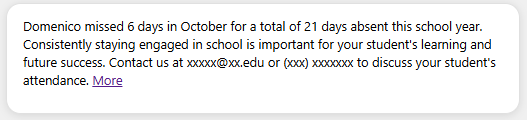
- Intro Message — the short SMS/email message recipients receive first
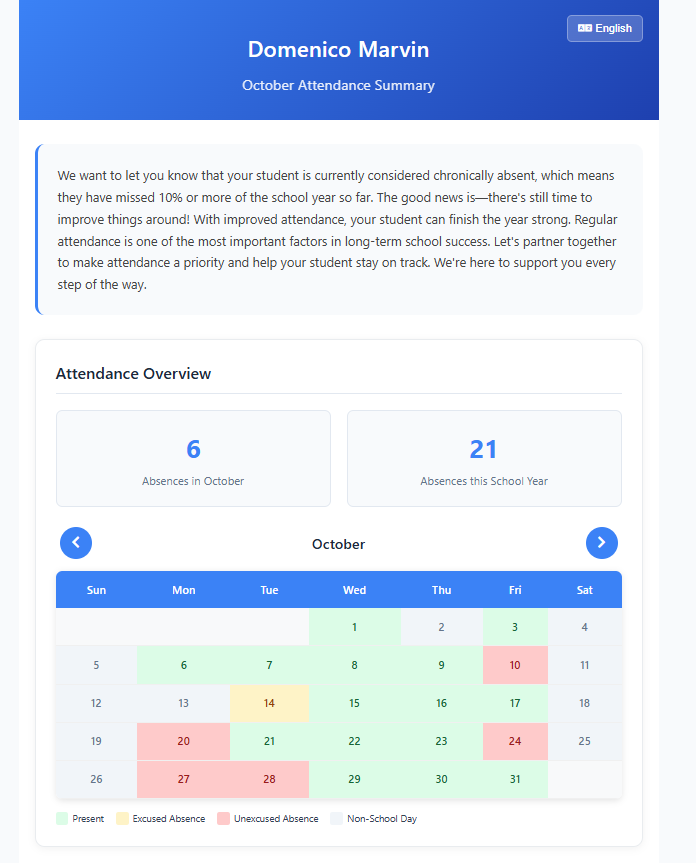
- Report Message — the detailed attendance summary page recipients see after clicking the More link
Nudges can be created for:
- A single school
- An entire district
Benefits of Attendance Nudges
Proactive Communication
Families receive attendance information before patterns become more severe.
Tiered Messaging
Students with different absence levels can receive different messaging.
Richer Context
The attendance report page allows schools to provide additional explanation, resources, and contact information.
Better Staff Follow-Up
The Stats tab helps staff track:
- Who was sent nudges
- Who viewed nudges
- Who was not sent nudges
Data Required From The District
Attendance Nudges rely on accurate attendance and roster data.
At minimum, districts should provide:
- Student roster and school enrollment mappings
- Attendance event/day data for the selected month
- Federal chronic absence rate data
- Guardian/student contact information for email/text delivery
Important Notes
- Students missing federal absence-rate data may display as N/A
- Students with incomplete contact information may not receive messages
Optional: Exclusion Percentage
You can optionally limit nudges to students under a certain federal absence-rate percentage.
Example:
- Exclusion Percentage = 90.0
How it works:
- Students above the threshold are excluded
- Students at or below the threshold remain eligible
Why Use An Exclusion Threshold?
This helps districts:
- Focus on early intervention
- Avoid generic messaging for highly chronic cases
- Prioritize students more likely to respond to light-touch outreach
Best Practices
- Leave blank to include all students
- Revisit thresholds monthly
- Use thresholds as part of a broader attendance strategy
Was this article helpful?
That’s Great!
Thank you for your feedback
Sorry! We couldn't be helpful
Thank you for your feedback
Feedback sent
We appreciate your effort and will try to fix the article